Confirm the problem before choosing the solution
A sewer lateral carries wastewater from the building toward a public main or an on-lot system. Slow drains throughout the house, repeated main-line clogs, sewage at a low fixture, or an unexplained wet area can justify investigation. None of those signs alone proves that the entire line needs replacement.
The first objective is to restore safe flow. The second is to document the line well enough to separate removable blockage from structural failure.
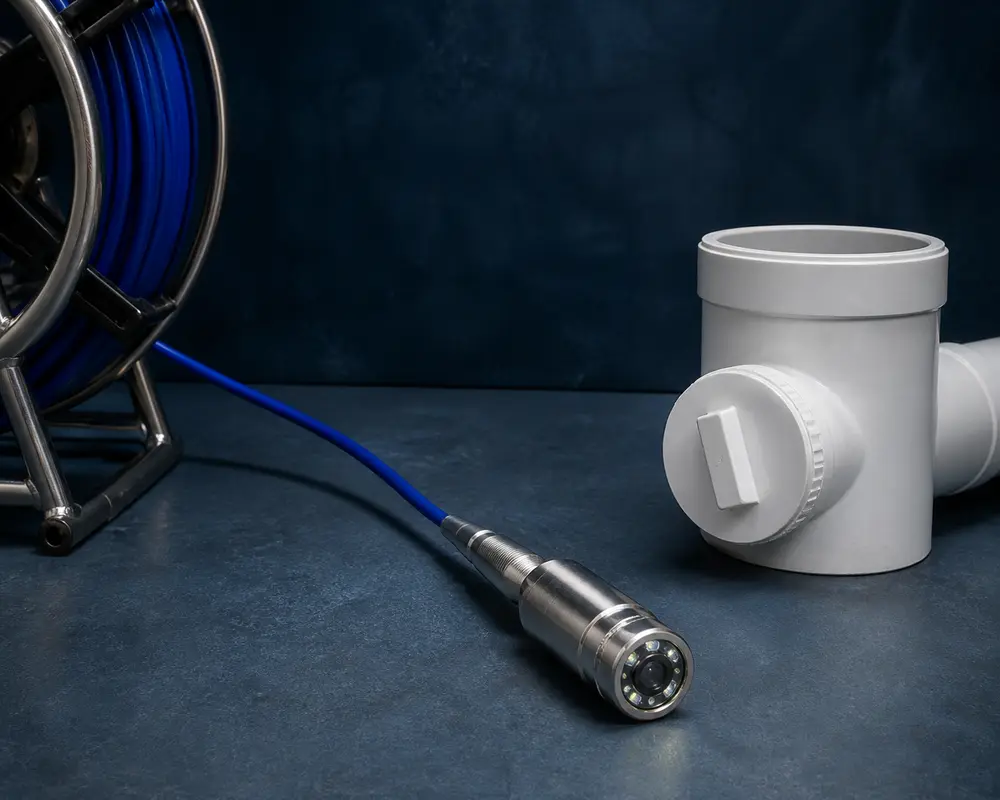
What a useful camera inspection includes
A camera inspection is most informative after the line is clear enough to see. Request a recording plus notes that identify:
- the access point and direction of travel;
- approximate distance from the access point;
- visible material and diameter where known;
- roots, offset joints, cracks, collapse, corrosion, or standing water;
- places the camera could not pass; and
- the proposed repair limits.
Distance is not the same as a marked surface location. If excavation is proposed, ask whether the defect was located above ground and how depth was estimated.
Four different paths after diagnosis
Cleaning only may be reasonable when the pipe is intact and the obstruction is removable. It should not be presented as a cure for a collapse or failed joint.
Spot excavation targets a defined defect. It can be efficient when the damaged area is short and accessible, but surface restoration and nearby utilities affect the project.
Open replacement exposes and replaces a longer run. It provides direct access but may disturb landscaping, pavement, walks, or interior slabs.
Trenchless rehabilitation or replacement can reduce surface disruption in suitable conditions. Lining and pipe bursting are different processes with different access and structural requirements. “Trenchless” does not mean no excavation, and not every damaged pipe is a candidate.
Scope drivers that matter
The pipe’s route, depth, material, length, access, and condition all shape the work. So do groundwater, rock, trees, retaining walls, property lines, easements, and other buried utilities. A proposal should distinguish pipe work from excavation, permits, traffic control, utility marking, testing, and surface restoration.
Pennsylvania One Call should be part of excavation planning, but public utility marking does not locate every private line on a property. Ask who is responsible for private-location work.
Establish ownership before signing
Do not assume the municipality owns everything outside the foundation. Responsibility for a lateral, connection, cleanout, or on-lot component varies by system and authority. Identify whether the home uses public sewer or an on-lot sewage system, then obtain the serving authority’s current rules.
Questions for the contractor and authority:
- Which exact segment is defective, and what evidence supports that conclusion?
- Who owns and maintains that segment?
- Which permits, inspections, or authority approvals apply?
- Is a cleanout, test, or post-repair camera record required?
- What surfaces will be disturbed and restored?
- What conditions could change the price or method after excavation begins?
Sewage safety
Stop water use during an active backup. Keep people and pets away, avoid direct contact, and do not run fans that can spread contaminated aerosols through the home. Do not combine chemical drain products or attempt to open a line containing unknown chemicals. Significant sewage cleanup is a remediation task, not simply part of clearing the pipe.
Reduce avoidable stress on the lateral
Keep wipes, hygiene products, grease, and hard objects out of drains. Do not plant new large-rooted vegetation over a known lateral without understanding the route. Save inspection video and repair records for future owners. If roots or buildup are repeatedly removed, use the documented condition—not an arbitrary cleaning calendar—to decide whether repair is warranted.
Bucks County verification points
Public sewer and on-lot systems, owner-responsibility boundaries, and permits vary by address in Bucks County. Pennsylvania DEP’s Act 537 framework provides statewide context but does not answer property-specific ownership. Confirm the serving authority and municipality. This site neither endorses a contractor nor promises that a particular repair method will work at a given property.
Sources
- U.S. Environmental Protection Agency — Sanitary Sewer Overflow Frequent Questions — https://www.epa.gov/npdes/sanitary-sewer-overflow-sso-frequent-questions
- U.S. Environmental Protection Agency — Sanitary Sewer Overflows — https://www.epa.gov/npdes/sanitary-sewer-overflows-ssos
- Pennsylvania DEP — Public and Private Sewer Systems — https://www.pa.gov/agencies/dep/programs-and-services/water/clean-water/wastewater-management/act-537-sewage-facilities-program/public-and-private-sewer-systems
- Pennsylvania Office of Attorney General — Home Improvement Contractor Registration — https://www.attorneygeneral.gov/businesses-and-organizations/home-improvement-contractor-registration/
- Pennsylvania Department of Labor & Industry — Contractor Licensing — https://www.pa.gov/agencies/dli/programs-services/labor-management-relations/bureau-of-occupational-and-industrial-safety/uniform-construction-code-home/contractor-licensing
- NASSCO — Pipe Rehabilitation — https://www.nassco.org/trenchless-technology/rehabilitation/pipe-rehabilitation/
- City of Portland Bureau of Environmental Services — Sewer Video, Photo, and Map Guidelines — https://www.portland.gov/bes/connecting-sewer/sewer-photo-video-map
- North Dakota State University Extension — Cleaning Sewage Backup — https://www.ndsu.edu/agriculture/ag-hub/cleaning-sewage-backup
Related video
How a Sewer Camera Inspection Works
This contractor-produced demonstration helps homeowners visualize the camera-inspection step used to locate and document sewer-line problems.
Video: How a Sewer Camera Inspection Works — Reliant Plumbing.
Context and limits: The publisher sells plumbing services. The video illustrates a process but does not establish the diagnosis, repair method, or contractor choice for a Bucks County property.