Start with the pattern
The number of affected fixtures is the most useful first clue. One slow sink often points to a local trap or branch obstruction. Several fixtures draining poorly—especially a toilet and a low shower or floor drain—can indicate a blockage farther downstream. Wastewater rising in another fixture is a reason to stop using water and arrange prompt service.
Do not keep “testing” a backup by flushing repeatedly. Every added gallon can push more wastewater into the home.
What commonly builds a blockage
Kitchen lines accumulate fats, oils, grease, and food residue. Bathroom branches collect hair, soap, and product buildup. Toilets and building drains can be obstructed by wipes, hygiene products, objects, scale, or damaged piping. A recurring main-line problem may involve roots, a sag, a separated joint, or a deteriorated lateral.
The label “flushable” does not guarantee that a wipe will break apart like toilet paper in a household drain or public collection system. Keeping wipes and grease out of drains is prevention, not merely etiquette.
Choose diagnosis before force
Professional cleaning methods are selected by location and pipe condition:
- Trap or branch access for a localized fixture problem.
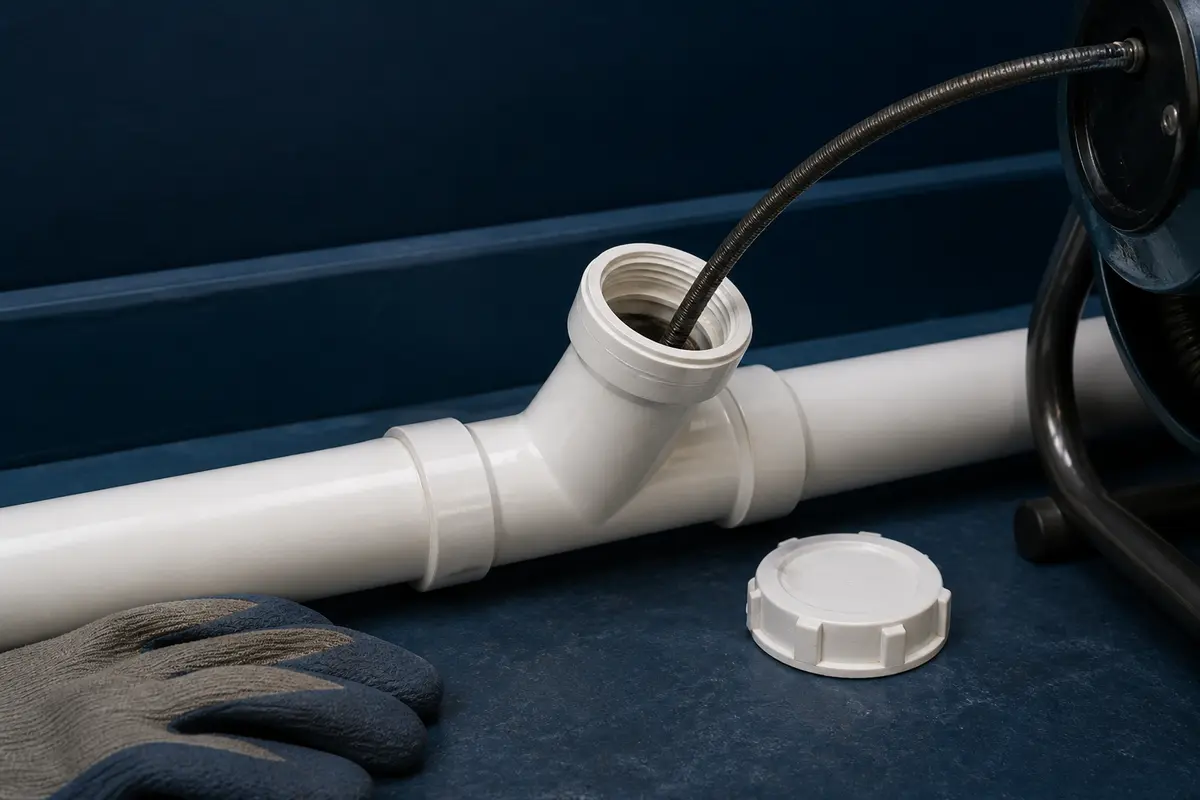
- Cable or auger work to cut through or retrieve an obstruction.
- Water jetting to scour certain types of buildup when the pipe and access are suitable.
- Camera inspection after flow is restored, especially for repeat blockages or suspected structural defects.
A camera image is not a complete diagnosis if the lens is submerged in dirty water. Ask whether the line was cleaned enough to see the pipe wall and whether the footage identifies a location, direction, and observable defect.
Repair may be different from cleaning
Cleaning restores flow; it does not repair a broken pipe, remove a persistent belly, or correct a failed joint. If a plumber recommends excavation, lining, or pipe bursting, ask for evidence of the condition and an explanation of why cleaning alone will not hold.
A useful scope identifies the access point, line segment, cleaning method, limitations, and follow-up. It should also say whether fixtures will be reset, whether a camera recording is included, and who handles cleanup if sewage entered the building.
Questions that improve the service call
- Which fixtures are affected, and where do you believe the blockage is?
- What access point will you use?
- Why is the proposed tool appropriate for this pipe material and condition?
- Will you inspect after clearing the line?
- If a defect is found, can I receive the video and location notes?
- Is the property owner responsible for this portion of piping?
- Do permits or utility coordination apply to any repair beyond cleaning?
Ownership boundaries differ among public sewer systems, private systems, and individual authorities. Confirm responsibility with the authority serving the property before authorizing work outside the building.
Chemical cleaner is not a neutral first step
Caustic or acidic drain products can burn skin and eyes, create dangerous fumes, and leave hazardous liquid for the next person who opens the line. Never mix products. If one was used, tell the plumber exactly what and when. A plunger or removable strainer may be reasonable for a simple fixture clog, but stop if sewage is present, the line repeatedly blocks, or force could damage old piping.
Prevention that matches the cause
Use sink strainers, collect cooking grease for disposal, put wipes in the trash, and address a frequently slow fixture before it becomes a full blockage. A recurring lateral obstruction deserves a documented diagnosis rather than an indefinite series of emergency cleanings.
For homes with a history of sewer backup, ask whether a properly located cleanout, backwater protection, or planned inspection would improve resilience. Those options depend on the building and local rules; they are not universal upgrades.
Bucks County project notes
Sewer ownership, permit requirements, and public-versus-private service vary by address. Pennsylvania’s sewage planning framework does not create one homeowner-responsibility rule for every Bucks County property. Verify the serving authority and municipality. The directory does not endorse a particular cleaning method or company.
Sources
- U.S. Environmental Protection Agency — Sanitary Sewer Overflow Frequent Questions — https://www.epa.gov/npdes/sanitary-sewer-overflow-sso-frequent-questions
- U.S. Environmental Protection Agency — Sanitary Sewer Overflows — https://www.epa.gov/npdes/sanitary-sewer-overflows-ssos
- U.S. Environmental Protection Agency — Household Hazardous Waste — https://www.epa.gov/hw/household-hazardous-waste-hhw
- Poison Control — What’s in Drain Cleaner? — https://www.poison.org/articles/whats-in-drain-cleaner
- Clemson Cooperative Extension — Fats, Oils, and Grease Pollution — https://hgic.clemson.edu/factsheet/f-o-g-fats-oils-and-grease-pollution
- City of Albany, Oregon — “Flushable” Wipes Clog Pipes — https://albanyoregon.gov/pw/wastewater/wipes
- Pennsylvania DEP — Public and Private Sewer Systems — https://www.pa.gov/agencies/dep/programs-and-services/water/clean-water/wastewater-management/act-537-sewage-facilities-program/public-and-private-sewer-systems
- This Old House — How to Snake a Clogged Drain — https://www.thisoldhouse.com/bathrooms/how-to-snake-a-clogged-drain
- Roto-Rooter — What to Expect During Water Jetting — https://www.rotorooter.com/blog/plumbing/what-to-expect-during-water-jetting-service
Related video
Fats, oils, grease and ‘flushable’ wipes are wreaking havoc on city pipes
A municipal public-works video shows why grease and so-called flushable wipes are common preventable causes of drain and sewer clogs.
Video: Fats, oils, grease and ‘flushable’ wipes are wreaking havoc on city pipes — City of Havre de Grace.
Context and limits: The examples are from Maryland; use the prevention principle as general education, not as Bucks County system guidance.