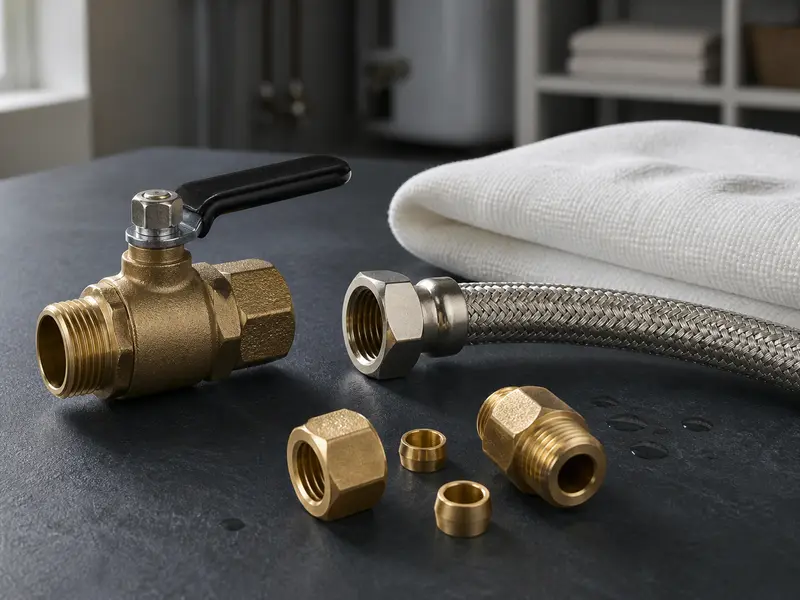
A stain is evidence, not a location
Water follows framing, pipes, and gravity. The wet ceiling may be several feet from the failed joint, and a damp wall can come from plumbing, a roof, condensation, or groundwater. Leak detection is the process of narrowing those possibilities before opening finishes.
If water is actively spreading, shut off the nearest safe valve or the main water supply. If the leak is slow, record when the evidence appears: after a shower, while an appliance runs, only during rain, or even when every fixture is off.
Build a timeline before opening anything
Useful observations include:
- whether the water meter moves when all fixtures and water-using appliances are off;
- whether the water is hot, cold, clean, discolored, or foul-smelling;
- which fixture use triggers the stain;
- whether pressure has changed;
- whether a toilet runs intermittently; and
- whether the moisture appears after weather events.
A higher bill can support a supply-leak theory, but it does not show where the leak is. Likewise, a dry meter test does not exclude a drain leak that appears only when a fixture is used.
How professionals narrow the search
The diagnostic sequence should move from broad and non-destructive to targeted:
- inspect visible fixtures, valves, appliance connections, and exposed piping;
- isolate branches or equipment and repeat flow tests;
- use moisture readings or thermal patterns to map the wet area;
- listen for pressurized leakage when conditions allow;
- test drains, pans, seals, or shower assemblies separately; and
- open the smallest practical area once evidence points to a location.
No instrument “sees through walls” with certainty. Moisture meters, infrared cameras, acoustic equipment, and pressure tests provide clues that still require interpretation.
Match the repair to the failure
A failed supply fitting may need a localized pipe repair. A leaking toilet seal requires resetting the fixture and checking the flange. A shower leak can involve the valve, drain, enclosure, or waterproofing—different trades may own different parts. A recurring pinhole leak can justify evaluating a larger piping run rather than automatically repeating a patch.
The plumbing repair and building restoration should be written as separate scopes when different companies are involved. Confirm who opens the wall, who dries the cavity, who checks for mold, and who restores paint, tile, flooring, or cabinets.
Ask for observable support
Before authorizing invasive work, ask:
- What evidence points to this location?
- Which other causes were ruled out?
- Is the leak on a supply, drain, fixture, appliance, or building-envelope system?
- Is the proposed opening exploratory or expected to expose the failure?
- Will the repaired section be tested before the wall is closed?
- Could this be one symptom of a broader material or pressure issue?
A good answer distinguishes fact from probability. “The meter shows continuous flow and the acoustic signal is strongest here” is more useful than “these houses usually leak in this spot.”
Moisture cleanup matters
Stopping the leak does not dry wet materials. The U.S. EPA advises prompt moisture control because mold can develop where materials remain damp. Do not disturb suspected asbestos-containing or lead-painted materials during exploratory demolition. Significant contamination, sewage, or hidden mold may require specialized assessment and remediation.
Avoid electrical hazards. Do not enter standing water near outlets or equipment, and do not operate wet appliances.
Reduce repeat leaks
Periodically inspect exposed valves, supply hoses, water-heater connections, refrigerator lines, and the spaces below sinks. Learn the meter and shutoff locations. Smart flow monitors and automatic shutoff devices may reduce the duration of some supply leaks, but they require correct installation and do not detect every drain or envelope leak.
Pennsylvania and local verification
Permit and plumbing-credential requirements can vary by Bucks County municipality. Pennsylvania HIC registration is not proof of a plumbing license. Verify the contractor, scope, and municipal requirement for the address. This guide does not diagnose a building, estimate damage, or recommend a listed plumber.
Sources
- U.S. Environmental Protection Agency — Fix a Leak Week — https://www.epa.gov/watersense/fix-leak-week
- U.S. Environmental Protection Agency — WaterSense Statistics and Facts — https://www.epa.gov/watersense/statistics-and-facts
- U.S. Environmental Protection Agency — Leak Detection and Flow Monitoring Devices — https://www.epa.gov/watersense/leak-detection-and-flow-monitoring-devices
- U.S. Environmental Protection Agency — A Brief Guide to Mold, Moisture, and Your Home — https://www.epa.gov/mold/brief-guide-mold-moisture-and-your-home
- Pennsylvania Office of Attorney General — Home Improvement Contractor Registration — https://www.attorneygeneral.gov/businesses-and-organizations/home-improvement-contractor-registration/
- Pennsylvania Department of Labor & Industry — Contractor Licensing — https://www.pa.gov/agencies/dli/programs-services/labor-management-relations/bureau-of-occupational-and-industrial-safety/uniform-construction-code-home/contractor-licensing
- Pennsylvania Department of Labor & Industry — Uniform Construction Code — https://www.pa.gov/agencies/dli/programs-services/labor-management-relations/bureau-of-occupational-and-industrial-safety/uniform-construction-code-home
- IAPMO/UpCodes — Leak Detection Devices — https://up.codes/s/leak-detection-devices
Related video
Fix a Leak with WaterSense!
EPA WaterSense provides a one-minute introduction to recognizing household water waste and checking for common leaks.
Video: Fix a Leak with WaterSense! — U.S. Environmental Protection Agency.
Context and limits: It is a national awareness video, not a technical diagnosis of concealed, slab, service-line, or drain-side leaks.