Last verified: October 5, 2026.
If your Levittown home loses heat, loses boiler pressure, or has a damp floor, act with care. The source may sit below the concrete slab.
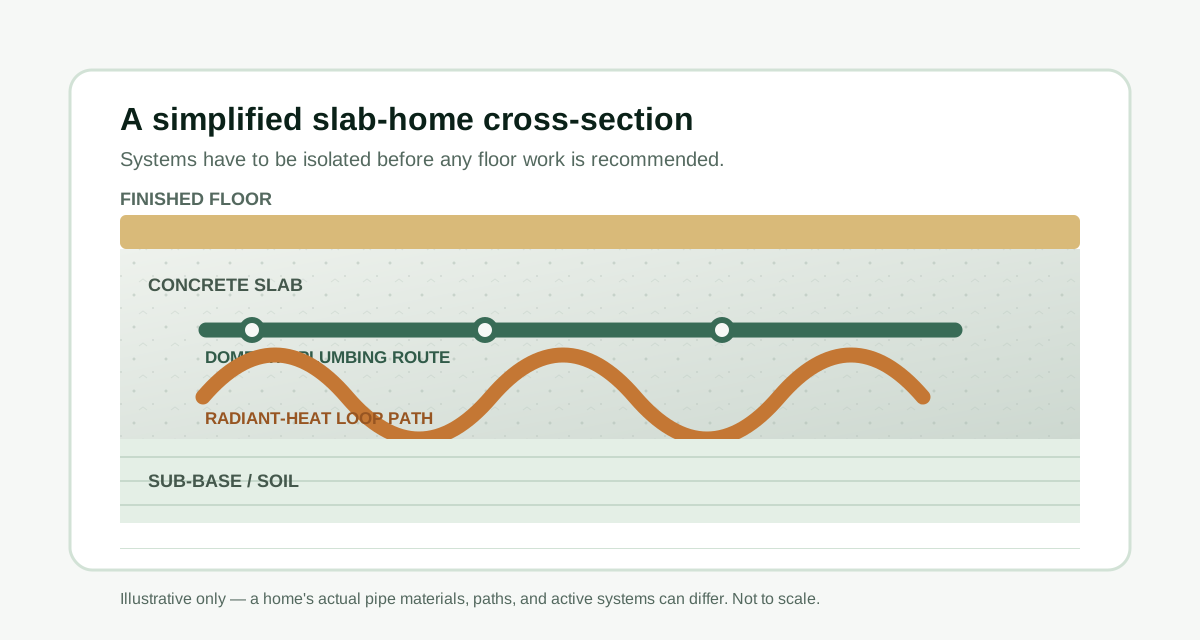
Some original homes used copper tubes in the slab for hot-water radiant heat. Those tubes serve the heating system, not your drinking-water plumbing.
Treat active water release as urgent. Shut off water and power to the affected area if safe. Call a qualified pro. Call 911 if there is immediate danger.
Do not cut the slab or disconnect heating pipes yourself.
1. Is this an emergency?
Active water release needs prompt attention. Shut off the main water supply if the leak appears to involve domestic water.
Shut off power to the wet area only if you can do so safely. Keep away from wet electrical equipment.
Call a qualified pro for suspected heating-loop leaks or concealed pipes. Call 911 if anyone faces immediate danger.
2. What is happening?
Levitt & Sons built Pennsylvania Levittown from 1952 through 1958. The community has more than 17,300 homes.
Those homes sit across Bristol Township, Falls Township, Middletown Township, and Tullytown Borough. Levittown is a Census Designated Place, not a separate municipality.
The six original models were the Levittowner, Rancher, Jubilee, Pennsylvanian, Colonial, and Country Clubber.
The homes used concrete slabs instead of basements. The original heating system used an oil-fired boiler and copper tubes in the slab.
A domestic water line carries water to faucets, toilets, and appliances. A radiant heating loop carries heated water between the boiler and the slab.
A sewer line carries wastewater away. These systems can create similar symptoms, so the professional must identify the source first.
Falling boiler pressure, poor heat in one area, or repeated refilling can point to a heating-loop problem. A damp floor does not prove that diagnosis.
Heating Help describes reports of leaking tubes soaking ground below older Levitt radiant systems. Its detailed examples mainly come from Long Island.
That source gives no leak rate or condition statistic for Bucks County. Reported abandonment after about 20 years also describes examples, not every Pennsylvania home.
Age alone does not prove that your home still has the original tubes. Owners may have changed to baseboard heat, PEX, or another system.
3. What will it cost, and how long will it take?
No reliable source reviewed for this rewrite gives a Levittown-specific price or repair time. Costs depend on the system, access, testing, and repair method.
Two vendor sources outside Pennsylvania give a rough cost shape. Space Coast Cooling & Plumbing, a Florida vendor, lists detection at $150–$600.
The same vendor lists many slab repairs at $1,500–$4,500. It says the final price depends on access and the repair method.
Elmer’s Home Services, a Texas vendor, cites a 2021 average of $2,280. It lists detection at $150–$600 and below-slab repairs at $500–$4,000 or more.
These are vendor-published figures, not Bucks County quotes. Do not treat them as a local promise or a final estimate.
Ask two qualified local professionals for written, itemized quotes. Each quote should separate testing, access, repair, restoration, permits, and expected time.
If a professional cannot identify the system, ask for the diagnostic cost before approving slab access.
4. Who should you call, and what should you ask?
Call a qualified plumber or heating pro who can test concealed water and heating lines. Choose someone who explains the evidence before recommending demolition.
Before the visit, gather these details:
- Note whether boiler pressure keeps dropping.
- Identify floor heat, baseboard radiators, or another heating method.
- Find boiler paperwork and heating-conversion records.
- Photograph damp areas without removing flooring.
- Record when symptoms began and where heat is missing.
Ask these questions:
- Are you testing domestic water, a radiant heating loop, or another source?
- What evidence supports opening the slab?
- Can visible equipment be checked first?
- If the loop failed, what repair options fit the current system?
Do not open the slab, drill into concrete, or disconnect heating pipes yourself.
5. What local rules apply?
Heating equipment and concealed piping may require registration, a license, a permit, or an inspection. Requirements depend on the municipality that governs the address.
Check current requirements with Bristol Township, Falls Township, Middletown Township, or Tullytown Borough, as applicable. Levittown crosses four municipalities.
One town’s rule should not be applied to another. Ask the professional which local approvals the proposed work needs.
No source reviewed for this rewrite verified one current rule for every Levittown address. That is why this guide does not state a single town-wide requirement.
6. How can you prevent a repeat problem?
Keep records of boiler replacements, heating conversions, loop abandonments, and concealed-pipe repairs. Give those records to the next professional before work begins.
Monitor boiler pressure and report repeated pressure loss. Ask for a system check before remodeling work could disturb the slab.
Do not drill, cut, or anchor through the slab without first checking for concealed heating tubes. Keep the system map with your home records.
A Levittown address does not prove a hidden heating problem. It tells you to identify the pipes before choosing a repair.
Sources
- Levittowns (Pennsylvania and New Jersey), Encyclopedia of Greater Philadelphia, accessed October 5, 2026. Supports the build period, home count, six models, four-municipality footprint, Census Designated Place status, and slab construction.
- Why Levittown Didn’t Revolutionize Homebuilding, Construction Physics, Brian Potter, July 25, 2024, accessed October 5, 2026. Supports slab construction, the absence of basements, and standardized construction details.
- Levittown Radiant Heating Systems, Heating Help, Dan Holohan, June 23, 2014, accessed October 5, 2026. Supports the radiant-system design, embedded copper tubes, reported leak behavior, and reported system conversions. Its detailed examples are mainly from Long Island.
- Levitt and Sons — Company Timeline, LevittownBeyond.com, Kevin Sylvester, last revised January 20, 2013, accessed October 5, 2026. Supports Pennsylvania construction history and the 17,311th home completion in 1958.
- How Much Does Slab Leak Detection Cost? A Price Guide, Space Coast Cooling & Plumbing, accessed October 5, 2026. Vendor source from Florida. Supports the $150–$600 detection range, $1,500–$4,500 repair range, and cost factors.
- Slab Leak Repair Costs Explained, Elmer’s Home Services, accessed October 5, 2026. Vendor source from Texas. Supports the 2021 $2,280 average, $150–$600 detection range, and $500–$4,000 or more below-slab repair range.
This guide is general information, not plumbing instruction, engineering advice, or a contractor recommendation.