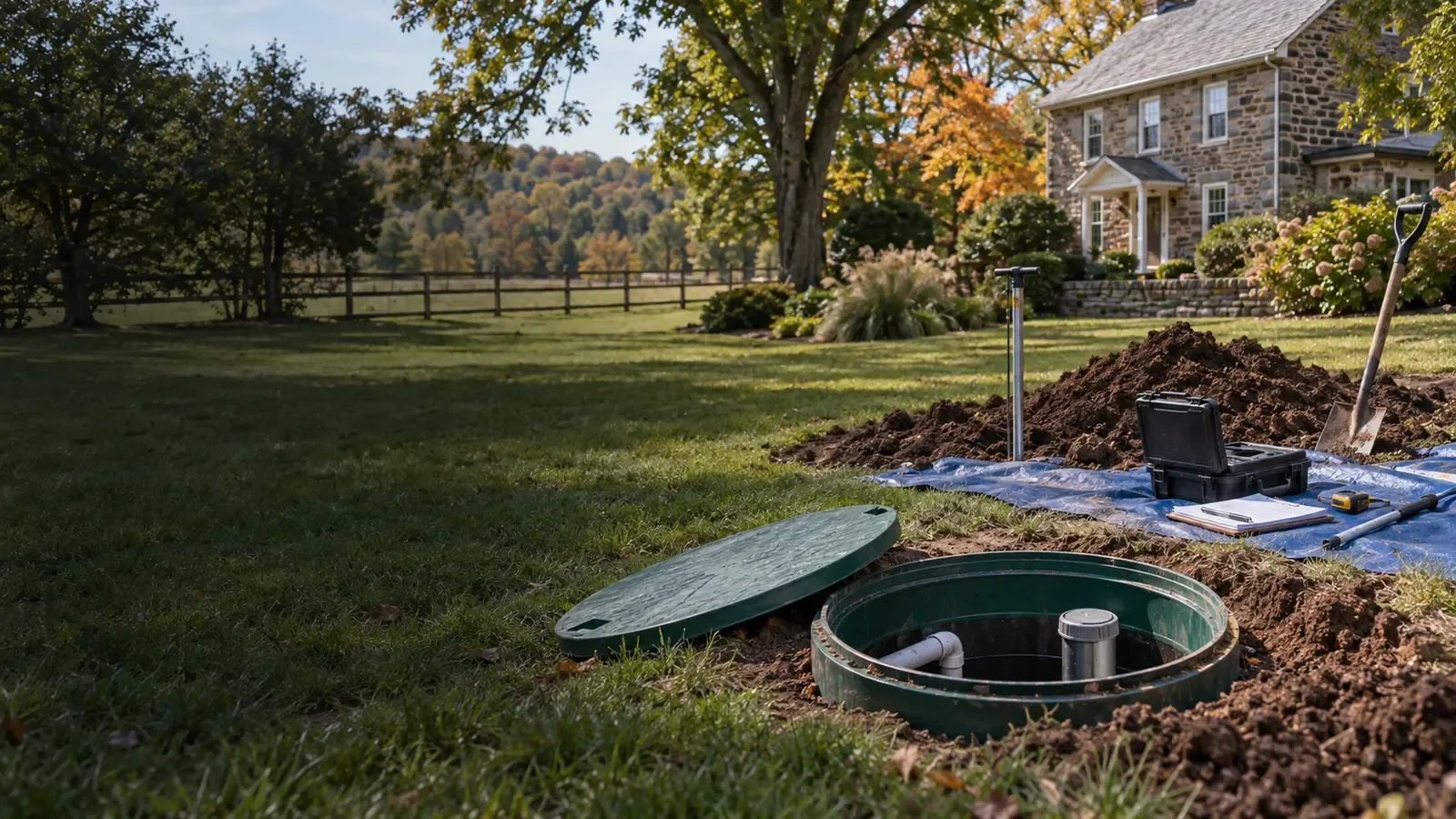
Last verified: September 14, 2026.
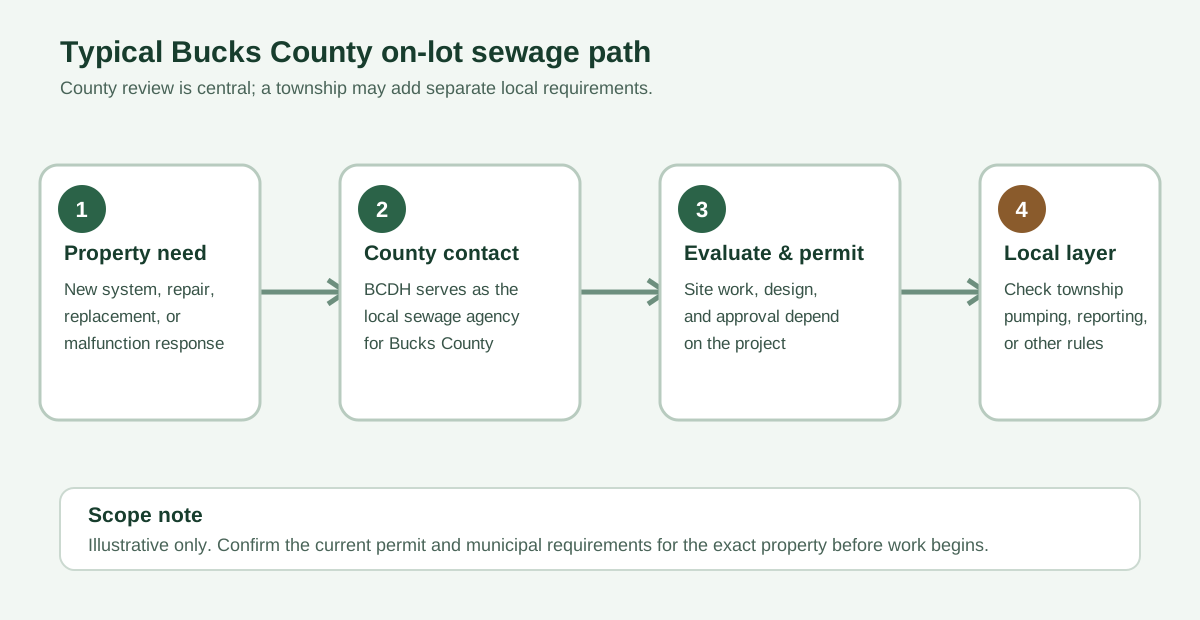
If your Bucks County home or business runs on a septic system, holding tank, or other on-lot disposal setup, your permit did not come from your township. It came from the Bucks County Department of Health (BCDH), under rules effective March 25, 2023. That single fact — that a county agency, not the municipality, is the “local agency” under Pennsylvania law — is the most important thing to understand before you sign a contract, list your house, or schedule a repair.
This article walks through what BCDH actually does, what your township may still require on top, and what a competent contractor should be able to tell you about each step.
Where the county sits in the Pennsylvania sewage chain
Pennsylvania runs on-lot sewage under the Sewage Facilities Act (Act 537) and its implementing regulation, Title 25, Chapter 73. PA DEP describes the on-lot portion of the program as “largely administered on the local government level” by individual municipalities, groups of municipalities, or — in Bucks County’s case — a county health department. DEP calls any of these a “local agency” and provides oversight and funding.
BCDH formally acts as that local agency. Its current rules adopt Title 25 Chapters 71, 72, and 73 by reference and state that they “shall apply to all municipalities in Bucks County within the jurisdiction of the Department.” In plain terms: for almost every property in the county that is not served by a public sewer, BCDH is the office that:
- Issues on-lot sewage permits for new construction, repairs, and component replacements.
- Reviews plot plans, soil testing, and percolation results.
- Conducts or oversees site investigations and trenching inspections.
- Approves an “Approval to Cover” that lets a structure actually be occupied.
- Licenses every sewage hauler vehicle that pumps or transports waste in the county.
- Receives written complaints about malfunctioning systems and pursues enforcement.
What BCDH does not do is decide whether a public sewer line will be extended to your road, or write municipal sewer ordinances. Those decisions live at the municipal and regional planning level under Act 537’s “planning module” process, not in BCDH’s permit file.
What your township can still layer on top
The county-level permit is not the whole picture. Several Bucks municipalities have adopted their own Sewage Management Programs (SMPs) under PA DEP authority that require periodic pumping and reporting. Plumstead Township, for example, requires on-lot systems to be pumped by a licensed hauler at least once every three years, with a copy of the pumping report submitted to the township within 30 days. The Township’s own language distinguishes between the two roles:
- BCHD issues the original permit, approves completion, and handles repairs.
- The Township tracks pumping cycles and may begin noncompliance enforcement (with District Justice fines up to $500 plus court costs) if a homeowner misses a cycle.
If your house is on a septic system, you may owe paperwork to both the county and your township, and a contractor who only deals with one of them is not seeing the whole picture.
What a repair permit actually involves
BCDH’s 2023 rules spell out a fairly detailed procedure for repairs. A competent contractor should be able to walk you through each of these steps and tell you what the county has asked for versus what they are recommending on their own.
- A written repair request on form SA-53 to the BCDH Environmental Health office, with the 2026 repair-evaluation fee ($600 for a repair with no additional flow).
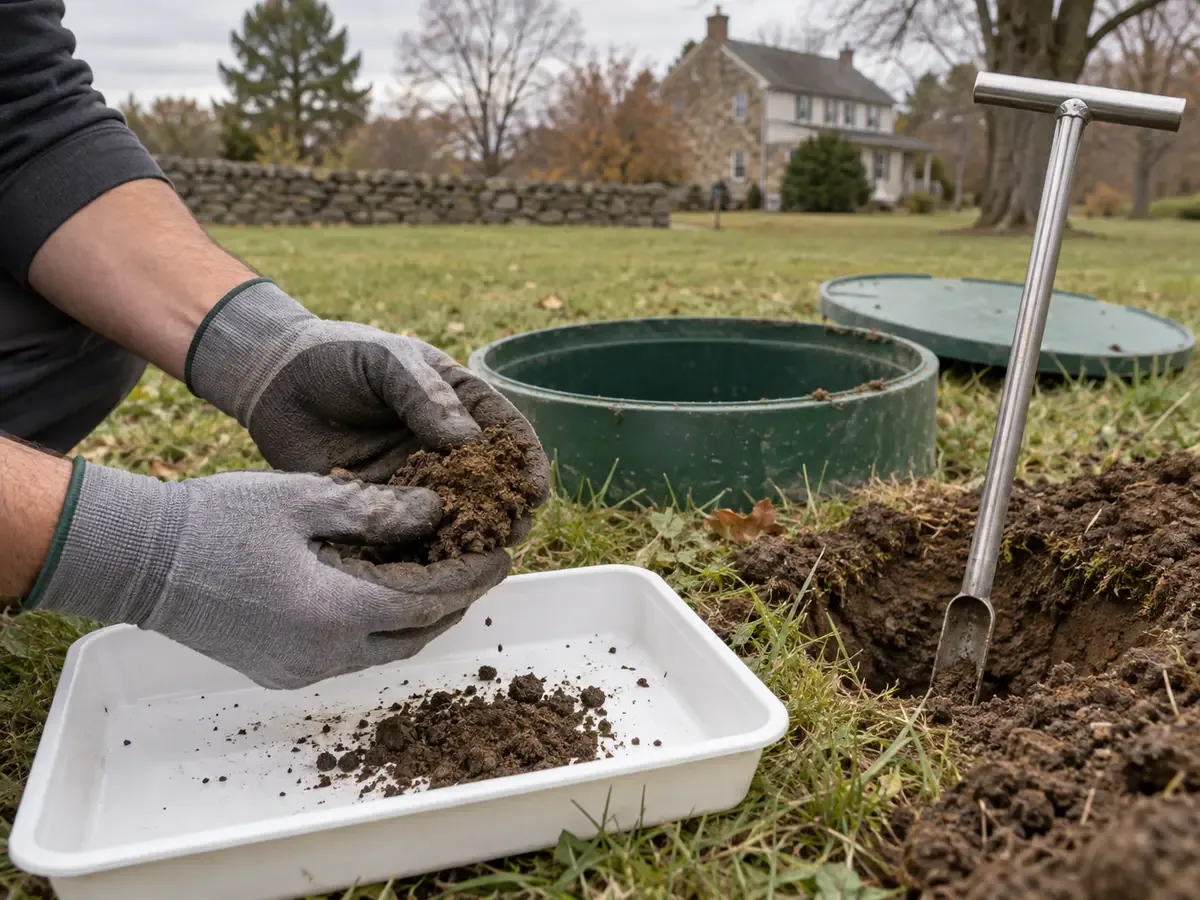
- A site evaluation by Department representatives, who will dig or require test pits in the proposed repair area and run percolation tests. Two test pits upslope and two downslope of the absorption area are the standard, with additional pits at the Department’s discretion.
- Plot plan and supporting data prepared by a Pennsylvania-registered Professional Land Surveyor or Professional Engineer, with seal/signature.
- An application fee that, for 2026, is $650 for a repair involving an absorption area, trench, bed, or drip field, and $225 for a repair limited to a component like a tank or baffle.
- A written “Approval to Cover” from the county’s Sewage Enforcement Officer after the system is installed. Until you have that in hand, you cannot lawfully occupy the structure.
In the Durham Carbonate Valley (parts of Springfield and Durham Townships and Riegelsville Borough) and the Buckingham Carbonate Valley (parts of Buckingham and Solebury Townships), BCDH also runs a stricter pre-site “office conference” because the limestone bedrock and karst features raise the stakes for groundwater contamination. In those areas, sinkhole remediation is prohibited on properties being considered for a system; any soil disturbance the Department finds can trigger a 100-foot isolation distance from the proposed absorption area.
The same rules forbid discharging roof gutter water, sump pumps, foundation drains, or surface runoff into a treatment tank or over an absorption area — a common cause of premature system failure that homeowners should flag during any repair conversation.
Options when the system is failing or undersized
Once BCDH is involved, a homeowner usually has four paths. A good contractor will explain each in terms of feasibility, time, and ongoing maintenance, not just the cheapest sticker.
- Repair the absorption area in place. Permitted as above. Often the lowest-cost path if soils, setbacks, and isolation distances still pass under the current Chapter 73 standard.
- Replace the tank and/or add an aerobic or alternate treatment unit. BCDH treats these as component changes ($225 in 2026) versus an absorption-area repair ($650), but an alternate or experimental system carries its own $850-per-EDU application fee and must be on PA DEP’s on-lot alternate technology listing.
- Install a holding tank (with a separate permit) when soil conditions simply cannot support a soil-absorption system. This is a regulated, recurring-cost path, not a one-time fix: the tank must be pumped by a BCDH-licensed hauler and the waste disposed at a PA DEP-permitted facility.
- Connect to public sewer, where accessible. Section 12.1 of BCDH’s rules prohibits new or continued on-lot use wherever an approved public sewer is “accessible.” Once the line is at the property line, the calculus shifts to the municipal authority’s connection rules and any Act 537 plan that triggered the extension.
For first-time sewer connections or system replacements that meet public-health standards, the PENNVEST Homeowner Sewage Program (administered by PA DEP in cooperation with PHFA) offers low-cost financing. Eligibility and current terms are set by PENNVEST, not by BCDH.
What to ask the contractor and the county
A useful answer should be specific, not vague. Some signals of a competent answer:
- “Who pulls the permit — you or me?” In Bucks, the application must be submitted by the property owner, an owner in equity, or a written authorized agent. The plot plan and supporting technical data must be sealed by a Pennsylvania-registered Professional Land Surveyor or Professional Engineer.
- “What fees are you collecting on the county’s behalf?” BCDH’s 2026 schedule lists specific dollar amounts and explicitly says all fees are non-refundable. A contractor who cannot itemize the county portion is asking you to take the total on faith.
- “Will BCHD do the site visit, or will you?” BCDH’s rules reserve site investigation, soil test pits, and percolation testing to Department representatives (with limited exceptions for trenching by a qualified consultant). A contractor who claims to “skip” this step is not working within the program.
- “Is the system on the PA DEP alternate technology listing?” Required for any aerobic or other non-conventional treatment unit. A “yes” with the listing number is a strong signal; a blank stare is not.
- “If I sell the house, what paperwork do I need?” The permit must be transferred to the new owner on BCDH form SA-51 ($200 in 2026). The original permit holder has not finished their obligation until that transfer is approved in writing. Some municipalities also require their own pumping-report handoff.
- “Are you and your pumper registered with BCHD and PA DEP?” Section 6 of the county rules requires every sewage hauler vehicle in the county to carry a BCDH license that expires September 30 each year. A pumper without that license is operating illegally, even if PA DEP paperwork is in order.
Pennsylvania does not have a statewide plumber license. Work that touches the building drain, vent, or water distribution inside the home is regulated by local registration (where a municipality requires it) and by the PA Home Improvement Consumer Protection Act for contracted home-improvement work — registration number, written contract, and the right to cancel. Verify any contractor’s HIC registration through the PA Attorney General’s online registry before signing.
Limits, responsibility, and where the county can fine you
A few boundaries are worth stating up front.
- Do not occupy the structure until BCDH issues Approval to Cover. Section 12.6 makes this an explicit rule. Skipping it puts a future sale, refinance, or insurance claim at risk even if the system is functioning.
- Do not pour or pump anything into the system that the rules don’t allow. Industrial waste, roof runoff, sump water, water-softener backwash into the wrong place, or any unpermitted discharge can be both a code violation and a public-health hazard.
- Expect enforcement to follow the property. Section 14 lets BCDH assess civil penalties of $300 to $2,500 per violation (with weekly accruals up to $2,500 per week for continuing violations after notice) and to docket unpaid penalties as judgments against the real property. First-offense summary criminal fines under Act 537 are $500 to $5,000 plus costs, with possible imprisonment up to 90 days.
- For emergencies, call 911 for any backup that threatens health, the BCDH Environmental Health line (215-345-3318 per the county program page) to report a malfunction, and your municipality’s sewer or public-works office if a main backup is suspected. Sewage in a finished living space is a health hazard that a contractor cannot fix by phone.
If you are reading this because of an active backup or surfacing waste in the yard, treat it as a sanitary emergency: keep people and pets away, do not attempt to open or pump the tank yourself, and contact a BCDH-licensed sewage hauler and the county Health Department in that order.
Sources
- Sewage Program | Bucks County, PA — official BCDH program page listing forms, fees, and the BCHD Environmental Health contact line (215-345-3318).
- Bucks County Department of Health Rules and Regulations Governing Individual and Community On-Lot Sewage Disposal Systems (PDF) — the controlling county regulation, effective March 25, 2023, including Sections 1–14 covering authority, definitions, permits, site evaluation, hauler licensing, transfer of permits, occupancy, and penalties.
- 2026 BCDH Fee Schedule ADM-71 (PDF) — current county fees for site evaluations, permit applications, transfers, and inspections.
- On-lot Disposal System (OLDS) | PA Department of Environmental Protection — state-level program description establishing that on-lot administration is delegated to local agencies, including county health departments, with DEP oversight.
- Sewage Management Program | Plumstead Township — example of a Bucks municipality that layers its own three-year pumping ordinance (Ord. 2021-05) on top of county permits, and that requires haulers to register with both the Township and BCHD.