Last verified: September 14, 2026.
What “Orangeburg” is in a postwar Lower Bucks yard
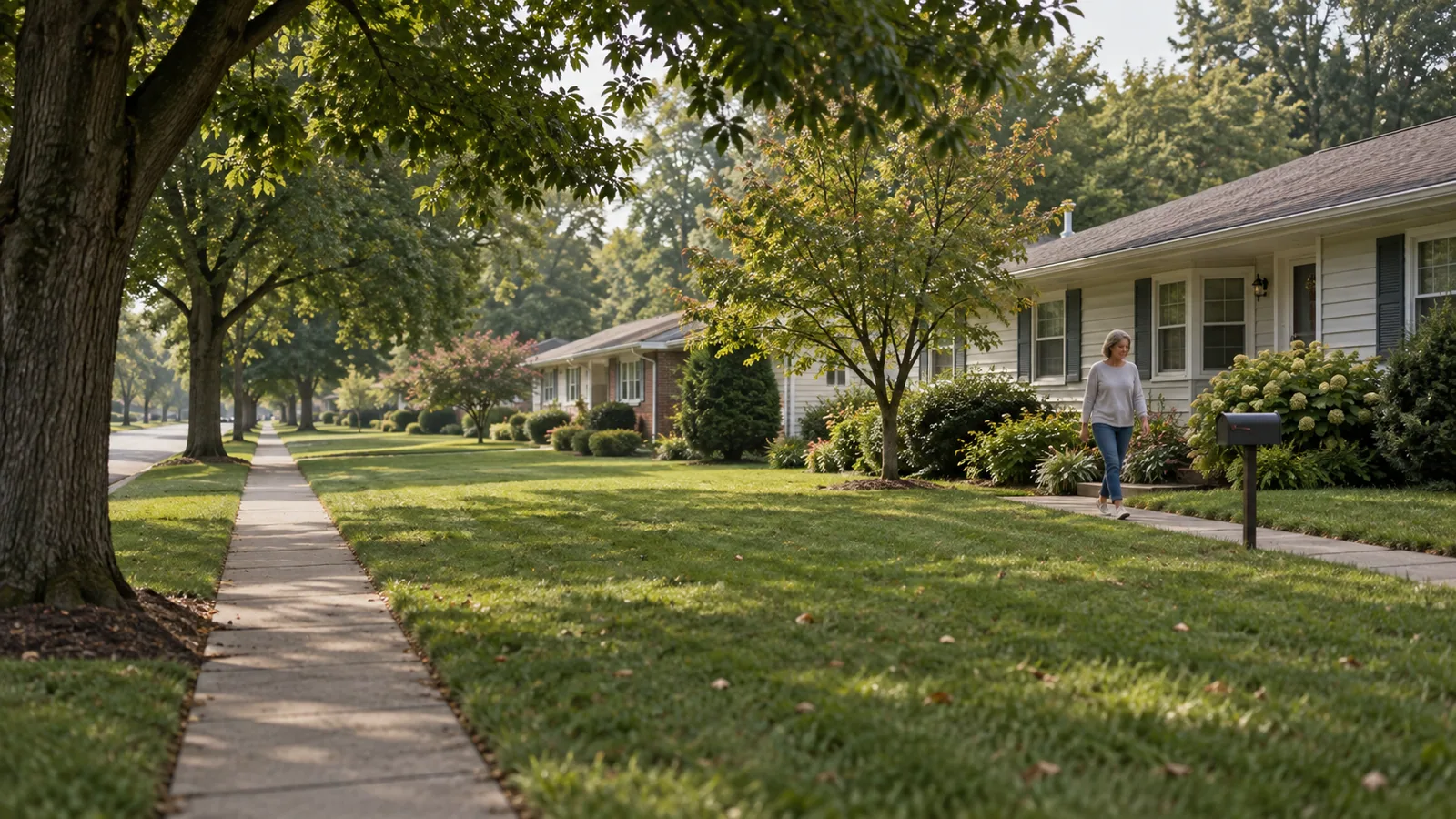
The lateral that runs from a house to the sewer main in the street is one of the few parts of a home that is built once, buried, and then mostly forgotten until it stops working. In the postwar tracts of Lower Bucks — Levittown, Croydon, Fairless Hills, and the surrounding Bristol, Falls, and Middletown township neighborhoods built between the early 1950s and the early 1970s — many of those original laterals are made of a material most people have never heard of: bituminized fiber pipe, sold most famously under the brand name Orangeburg.
What is actually in the ground is a thick-walled tube of compressed wood-pulp fibers soaked through with coal-tar pitch. It is light, soft enough to cut with a handsaw, and was the cheap, available answer to a sewer-lateral material shortage when the postwar housing boom began. The product was a nationally recognized standard in 1944, when the U.S. Department of Commerce promulgated a federal commercial standard for “bituminized-fibre drain and sewer pipe,” covering diameters from 2 to 8 inches and explicitly listing “house connections to sewers and septic tanks” as a primary intended use (U.S. National Bureau of Standards, CS116-44, 1944).
The catch is that the same properties that made it cheap and easy to install — soft wall, tar binder, paper-thin layers — also describe most of its failure modes today.
Where Lower Bucks meets a 1944 federal standard
The Pennsylvania State Museum’s documented history of Levittown, Pennsylvania — written with Franklin & Marshall College — says it directly: Levitt’s “tarpaper composition sewer pipe” was a deliberate cost-cutting choice. It saved money at install but “proved unstable,” and homeowners were “often forced to pay thousands of dollars to install new, copper lines — generally after Levitt’s five-year warranty had expired” (State Museum of Pennsylvania, “Levittown, Pa.: Building the Suburban Dream”).
What the State Museum calls “tarpaper composition sewer pipe” is the same material described in the 1944 federal standard and in city inspection records from comparable postwar communities: bituminized fiber, made by several competitors under brand names like Orangeburg, Bermico, and KYOVA (City of Ann Arbor, “Orangeburg Sewer Piping”). Croydon, Fairless Hills, and the rest of the Levittown-area postwar housing stock sit in the same era and the same nationally standard product market; the State Museum’s exhibit is the closest retained primary documentation that any of those Lower Bucks neighborhoods actually have this material in the ground.
The limits of that evidence are worth naming. The State Museum describes the material in general terms, not lot by lot. No retained source provides a street-by-street list of which Lower Bucks homes still have original bituminized fiber laterals, and this article does not claim to have one. The article also does not claim that every postwar Lower Bucks house has this material — there is no consistent pattern, and any individual answer requires a physical inspection.
What a camera inspection actually shows on this material
A qualified plumber’s first step on a suspected Orangeburg lateral is almost always a closed-circuit television (CCTV) camera pushed up the line from a cleanout. The camera is what separates guesswork from evidence, and the report it generates is the document a homeowner should end up with on paper or screen.
On a bituminized fiber lateral, the camera typically shows one or more of the following patterns, each of which corresponds to a known failure mode:
- Loss of circular cross-section. The pipe is no longer a true circle. Most often it flattens along the bottom — the invert bows upward under soil load — so what the camera sees is an oval or a kidney shape instead of a round pipe.
- Delamination from the inside out. The interior layers of the wall blister, flake, and separate. A snake or cutter sent through the line can pull back pieces of layered pipe material, which is one of the easiest field identifiers.
- Offset or separated joints. Where soil bedding has shifted, the tapered joints that were never glued can pull apart. Tree roots get in through those gaps.
- Solvent softening. Because the binder is coal-tar pitch, anything a homeowner poured down the drain that contains solvents — paint thinner, mineral spirits, certain drain cleaners, adhesives — accelerates the wall breakdown.
A video scan is the standard municipal inspector’s tool for identifying the material and its condition (City of Ann Arbor). The most widely used coding language for what the camera shows is NASSCO’s Pipeline Assessment Certification Program (PACP) for mainlines and Lateral Assessment Certification Program (LACP) for the building sewer — operators who hold PACP or LACP certification are trained to describe the same set of observations in the same standardized terms (NASSCO, PACP | LACP | MACP).
Two things the camera cannot always do are worth understanding. If a section has already collapsed or is packed with soil or roots, the camera may not get past the failure point, and the plumber is then looking at only part of the line. And no camera inspection can predict exactly when a partially deteriorated pipe will finally fail — it can grade severity and document the existing defects, not give a warranty date.

Why lining is usually off the table for this lateral
Cured-in-place pipe (CIPP) lining — where a resin-soaked liner is inverted or pulled into the existing pipe and cured in place — is a common solution for clay, cast iron, and PVC laterals. On a typical Orangeburg lateral it usually is not a workable option, and the reason sits inside the failure modes above.
Lining assumes the host pipe is roughly round, intact enough to give the liner something to bond to or press against, and not actively shedding material into the new pipe. A bituminized fiber lateral that has already ovalized, lost the bottom of its invert, or is delaminating from the inside out does none of those things. Pushing a liner through a deformed or partially collapsed host risks the liner wrinkling, leaving a low spot where solids will catch, or not curing evenly. The contractor may also find that the wall cannot be cleaned aggressively enough to prep for a liner without taking more of it away.
The City of Ann Arbor’s public guidance names the same family of solutions without naming lining at all — open trench replacement is described as “the standard method,” with pipe-bursting identified as an emerging trenchless alternative (City of Ann Arbor). A homeowner should expect a qualified plumber to explain why any particular method fits or does not fit the specific lateral being inspected, rather than assume any one method is universally correct.
Replacement paths worth comparing side by side
When the camera report and the plumber’s on-site judgment both point toward replacement, three broad approaches come up in Lower Bucks. Each has trade-offs that are worth asking about rather than guessing at.
- Open trench replacement. The traditional method: excavate the full length of the lateral, remove the failed pipe, lay new pipe (today typically PVC SDR-35 or SDR-26 for the building sewer, with code-required slope and bedding), and backfill. This is what most residential sewer contractors in this region do by default for a failed bituminized fiber lateral. It is disruptive to landscaping, driveways, and any hardscape over the line.
- Pipe-bursting. A trenchless method that pulls a bursting head through the existing lateral, fracturing the old pipe outward and pulling in new HDPE pipe behind it. Requires access pits at each end rather than a continuous trench. Faster landscape recovery, but the contractor has to confirm the host pipe, surrounding utilities, and soil conditions are compatible. Pipe-bursting on Orangeburg laterals has become more common in residential work over the last decade but is still not every contractor’s everyday job.
- Sectional replacement or point repair. If the camera shows failure concentrated at one offset joint or one root intrusion, it is sometimes possible to dig two pits and replace only the bad section. This is only realistic if the rest of the lateral is in good condition, which the camera report should establish. A homeowner should be cautious about paying for a point repair on a pipe that is delaminating along its whole length — the next failure is then just a matter of when.
A responsible plumber will base the choice on the camera report and on site conditions, will explain why the chosen method is right for that specific lateral, and will put the scope of work and the materials in writing before excavation starts.
What a homeowner should pin down before signing a quote
A camera report, a written scope, and a clear answer to a few practical questions are the difference between a one-day fix and a string of callbacks. Useful signals when talking to a qualified plumber:
- The camera report and its coding standard. Ask whether the operator is PACP- or LACP-certified, what version of the standard is being used, and whether the report will be delivered as video plus a written condition log with codes (material, defects, locations, severity grades).
- The exact material being installed. Today that is most often PVC SDR-35 for the building sewer; the contractor should name the pipe, the standard it meets (ASTM D3034 or the current equivalent), and the fittings.
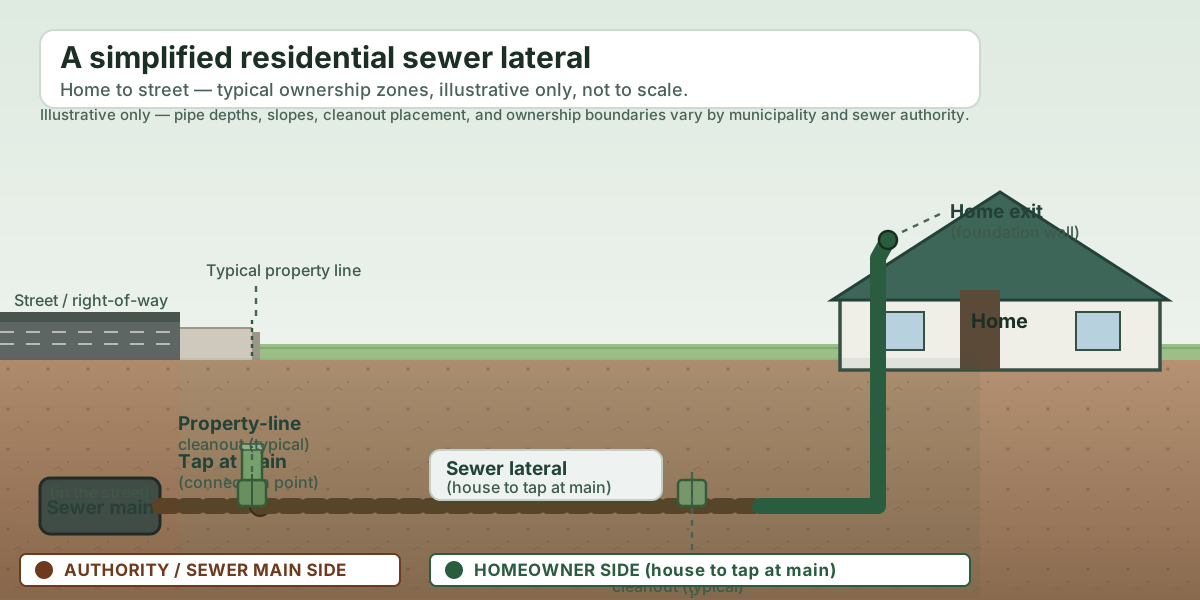
- The lateral’s full length and its connection to the main. Who owns the connection at the curb or sidewalk — the homeowner, the sewer authority, or both — affects who is responsible for what, and the plumber should know.
- The scope of restoration. Driveway, walkway, patio, lawn, plantings. Anything not named in the quote is a candidate for a surprise charge.
- The permits and inspections. Sewer-lateral work in Bucks County municipalities typically requires a plumbing permit and a final inspection; the contractor should pull the permit and arrange the inspection.
- Warranty terms in writing. Both on the work and on the materials.
Where the homeowner’s responsibility ends and the sewer authority’s begins
The sanitary sewer lateral — the pipe from the house to the sewer main — is, as a general rule, the homeowner’s responsibility from the house to the tap at the main. The Lower Bucks County Joint Municipal Authority and the local municipalities handle the sewer main in the street and the tap itself, but the homeowner is normally responsible for everything on the house side of that connection. Where exactly the dividing line sits, and which side of the curb stops being the homeowner’s problem, varies by municipality; the local sewer authority and the township or borough office are the right places to confirm the current rule for a specific address.
Two practical boundaries to keep in mind: do not pour solvents, paints, or chemical drain openers down any drain in a house with an older lateral — they accelerate the exact wall-softening failure mode the camera is looking for — and treat any backup that affects multiple fixtures as an immediate reason to stop running water and call both a qualified plumber and, if sewage is backing up into living space, the local emergency sewer authority. A broken or blocked lateral is not a do-it-yourself repair; it is excavation, specialized equipment, and permit-backed work.
Sources
- U.S. Department of Commerce, National Bureau of Standards. Commercial Standard CS116-44: Bituminized-Fibre Drain and Sewer Pipe. Promulgated March 10, 1944. https://nvlpubs.nist.gov/nistpubs/Legacy/CS/cs116-44.pdf
- City of Ann Arbor, Planning & Development Services, Construction Services. “ORANGEBURG” Sewer Piping (Bituminous Fiber Pipe). https://www.a2gov.org/media/42ilan0h/orangeburg_piping_information.pdf
- The State Museum of Pennsylvania, in partnership with Franklin & Marshall College. Levittown, Pa.: Building the Suburban Dream — “The Most House for the Money” / “Cost-Conscious Architecture.” Internet Archive capture, 2020. https://web.archive.org/web/2020/http://server1.fandm.edu/levittown/one/d.html
- National Association of Sewer Service Companies (NASSCO). PACP | LACP | MACP (Pipeline, Lateral, and Manhole Assessment Certification Programs). https://www.nassco.org/education-and-training/pacp-lacp-macp/